
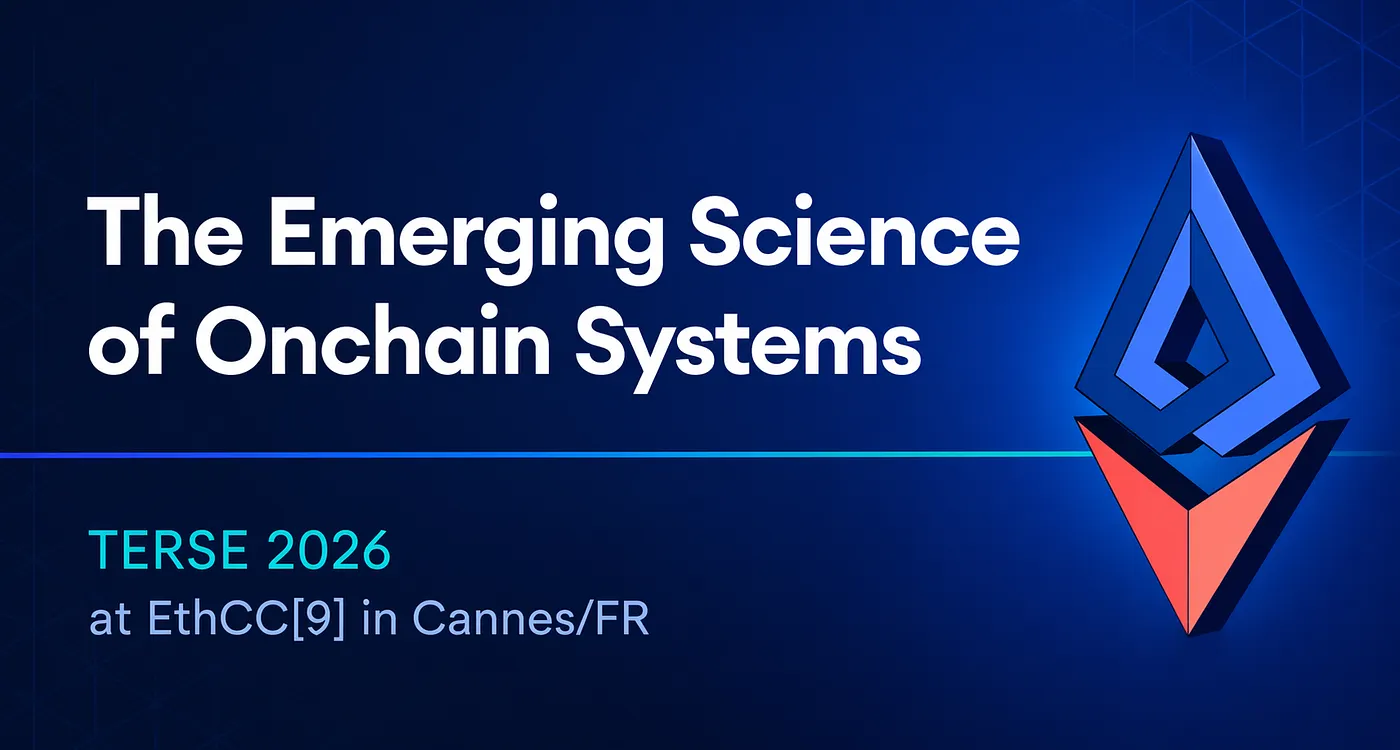
The Token Engineering Research Symposium (TERSE), held during EthCC[9] in Cannes, brought together researchers and builders focused on mechanism design, onchain market structure, and decentralized systems.
Alongside TERSE, the Token Engineering Breakout Sessions extended this work into a more applied setting. Together, the two events created space for something that remains rare in the broader ecosystem: focused, research-driven discussion grounded in real systems.
The models, assumptions, and design patterns underpinning decentralized systems are still being tested, refined, and — in settings like TERSE — actively challenged.
TERSE 2026 was co-hosted by Bancor in collaboration with Token Engineering Academy, EthCC, UZH Blockchain Center, and Token Engineering Labs, with IEEE Blockchain serving as a knowledge partner.
A Forum for Research, Not Promotion
TERSE was structured as an academic forum.
Presentations emphasized:
Clear problem statements
Explicit assumptions
Defensible methods
Honest treatment of results and limitations
Encourage further research
Across arbitrage, staking dynamics, privacy, governance, and lending, a common structure emerged:
Systems behave in ways that are not always intuitive
Incentives interact in ways that are not always linear
Design decisions propagate consequences across layers
The goal was not to present polished narratives, but to examine ideas — and to do so in a way that invites scrutiny and discussion.
Speaker Contributions
Each researcher approached decentralized systems from a different angle — but the work shared a common focus: understanding how these systems behave under real conditions.
The presentations were grounded in deployed environments, constrained by execution, and shaped by adversarial realities.
Below are brief introductions from each speaker, along with links to their full presentations.
Stefan Loesch | Principal, topaze.blue and Consultant, Bancor
Making Arbitrage Work
This talk presents a fast algorithm for finding optimal arbitrage across many AMMs. By reducing convex optimization to marginal-price root finding, it achieves up to 200x speedups and works reliably with concentrated and leveraged liquidity.
Amit Chaudhary | Founder, Palliora
Stabilizing the Staking Rate, Dynamically Distributed Inflation and Delay Induced Oscillations
This paper investigates how feedback delays and high yield sensitivity cause staking rate oscillations in PoS protocols. We propose a “stability corridor” model that dampens these cycles to ensure network security.
Alejandro Ranchel-Pedrosa | Protocol Researcher, Sei
Sedna: How users can enforce affordable privacy, censorship-resistance and MEV protection in MCP chains.
Sedna replaces naive transaction replication in multi-proposer blockchains with rateless erasure coding, achieving 2–3x bandwidth efficiency while preserving censorship resistance and reducing MEV exposure through until-decode privacy.
Tiago Santana | Lead, Floors Finance
Primary AMMs: Designing Financially Composable Tokens at Issuance
This talks examins how primary AMMs, where the protocol operates as a continuous counterparty, transforms tokens from passive units of account into self-contained financial systems with the native market structure, backing and capital utility.
Krzysztof Gogol | DeFi & Digital Assets
AI as a Curator Layer for DeFi Lending: From Static Rules to Adaptive Risk Management
Decentralized lending still relies on static interest-rate rules. This talk shows how AI and reinforcement learning can act as a control layer for DeFi lending, dynamically adjusting rates and risk parameters using onchain data and stress scenarios.
Suhyeon Lee | Visiting Research Fellow, Hashed Open Research
Economic Security in Optimistic-Style Challenges
Are challenge-based optimistic protocols truly incentive safe? I highlight failure of single-winner designs, and examine scenarios where partial burn and multi-winner rewards best align honest participation without overreliance on assumptions.
William George | Research Lead, Kleros Cooperative
Voting and Vote Splitting in Crypto-economic Systems
We consider how vote splitting between similar options manifests itself with subtle differences in settings such as governance voting DAOs, voting in Schelling-point oracles such as Kleros and UMA, and choosing a fork in a consensus algorithm.
Oghenekaro Elem | Founder, Parametrig
Legitimate Overrides in Decentralized Protocols
A 5x3 taxonomy and stochastic model for emergency interventions, analyzing 600+ exploits ($10B) to quantify the trade-offs between speed, scope, and legitimacy in DeFi. We provide a rigorous framework for “Legitimate Overrides.”
Mark Ballandies | Senior Researcher, UZH Blockchain Center
To Incentivize or Not: Impact of Blockchain-Based Cryptoeconomic Tokens on Human Information Sharing
Do tokens really boost data sharing? We ran a 132-person experiment on payment and reputation tokens. See what increases useful, accurate, contextual information (and what kills motivation), plus a surprising two-token interaction.
TERSE Steering Committee | Angela Kreitenweis, Mark Richardson, Mark Ballandies, Kris Paruch, Robert Koschig
The Cost of Entry — A panel discussion with the TERSE Steering Committee
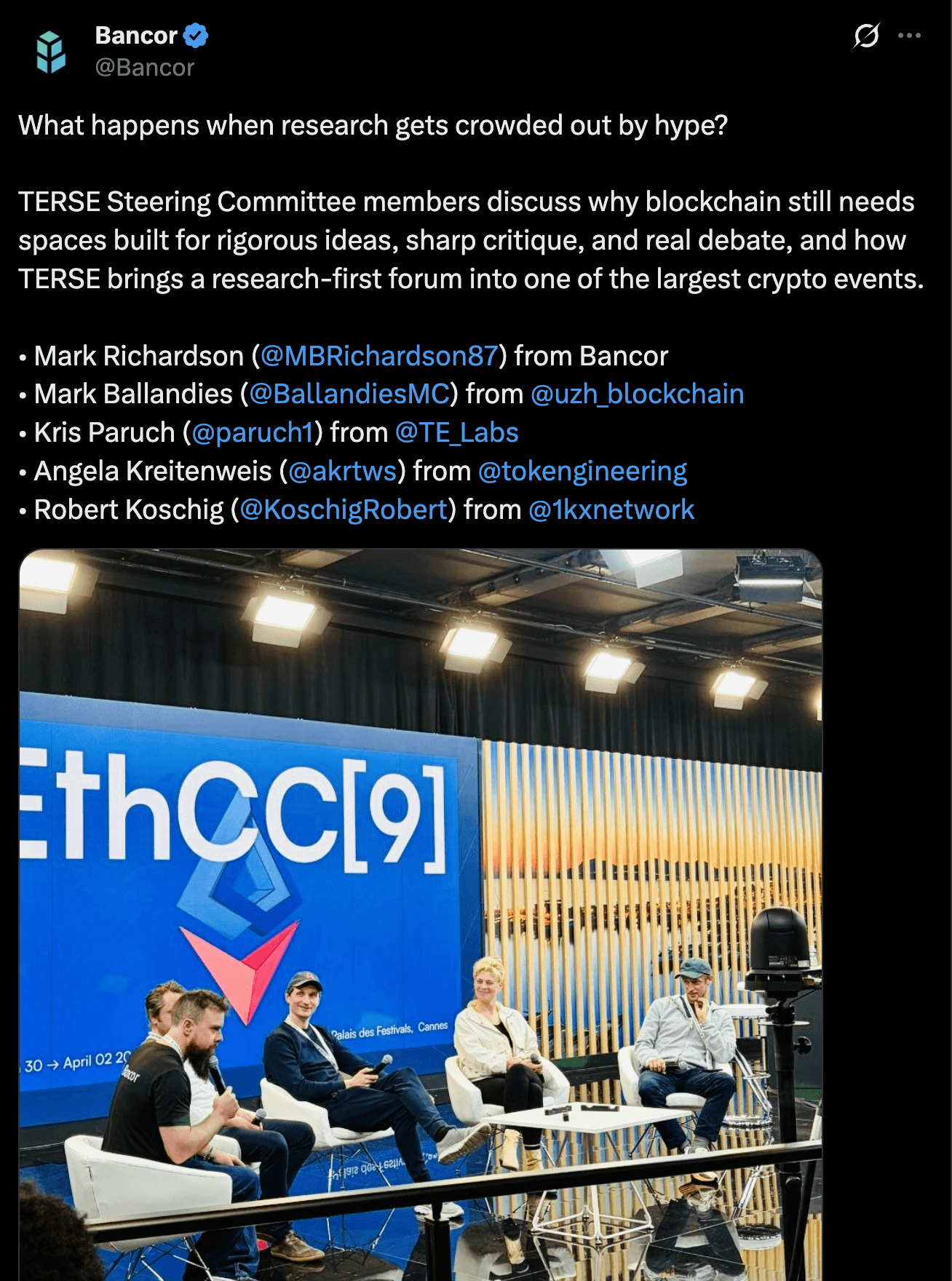
What happens when research gets crowded out by hype? This panel explores why blockchain still needs spaces built for rigorous ideas, sharp critique, and real debate, and how TERSE brings a research-first forum into one of the largest crypto events.
The Breakout Sessions: Designing in Public
The Token Engineering Breakout Sessions extended this work into a more interactive format.
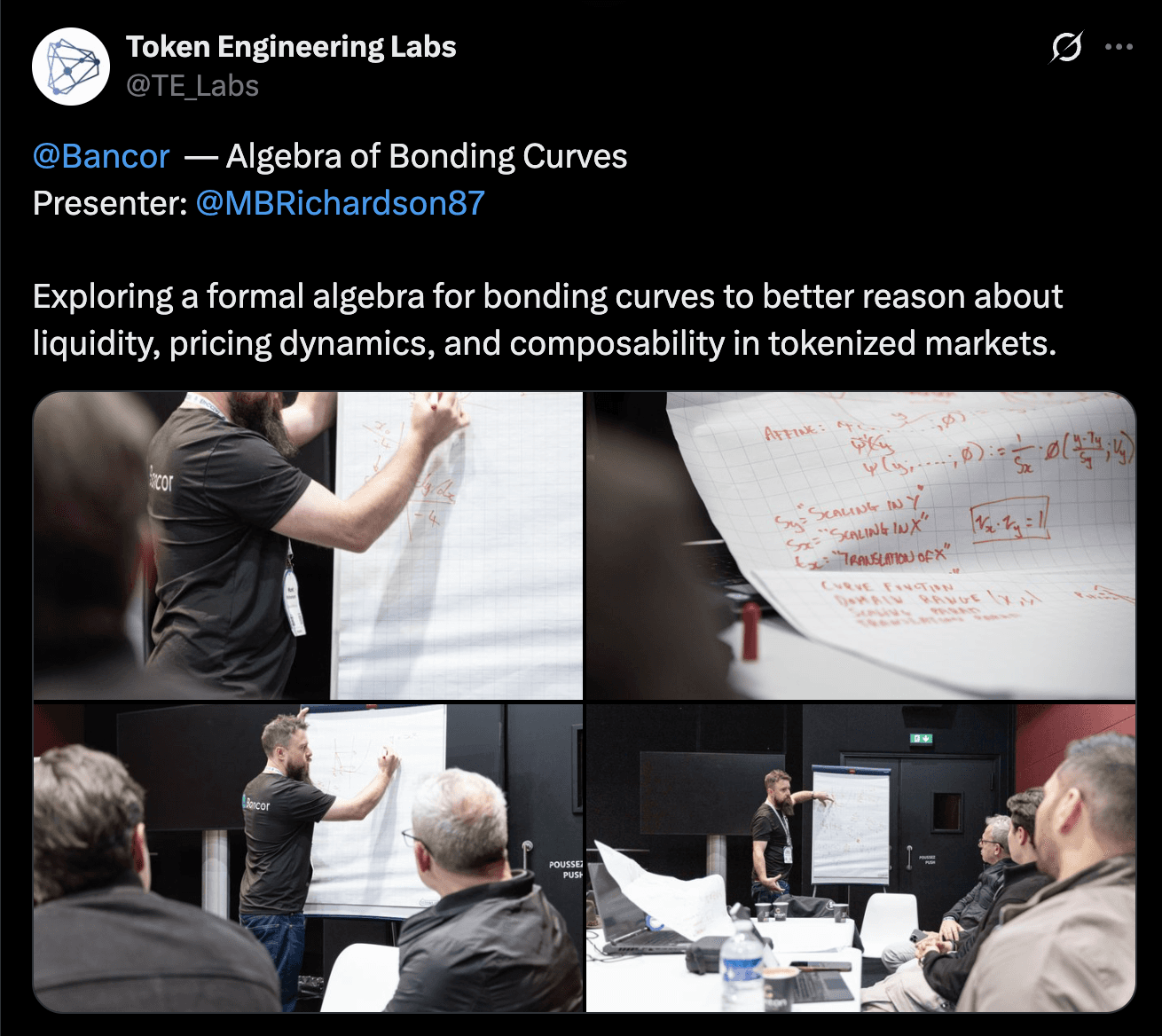
Participants worked through real design problems in small groups, exposing something that formal presentations often obscure:
assumptions break quickly when confronted with implementation.
Trade-offs become visible.
Edge cases surface.
Design decisions lose abstraction and gain consequence.
This is where much of the research focused — not on what systems should do, but on what they actually do.
A Discipline Without a Playbook
Token engineering, as reflected in TERSE, is not yet a fully formed discipline.
There is:
no unified framework
no standard methodology
no formal path of training
And yet, the need for one is becoming increasingly clear.
TERSE demonstrated that this discipline does not emerge through theory alone, but through:
deployed systems
observed failures
and iterative refinement
TERSE exists to create space for this type of work.
Not polished narratives.
Not product announcements.
But:
explicit assumptions
testable ideas
and open critique
Watch the Full Presentations
All presentations from TERSE are available at https://ethcc.io/archives?event=EthCC[9]&subject=TERSE&search=.
Closing
Thank you to everyone who contributed to TERSE — speakers, peer reviewers, participants, attendees, and collaborators.
The discussions that took place in Cannes are part of a broader effort to better understand and design the systems that underpin this industry.
That work continues.
From May 8–10, 2026, at the Ethereum Research Symposium (EthReS) at ETHPrague, Bancor Project Lead Dr. Mark Richardson will present new work on exchange design:
An Arbitrary Mean-Rate Exchange Protocol and the Mean-of-Derivatives (MoD) framework — a new DEX design that inverts bonding curve engineering.


