
Web2 assumed the interface was everything. If you could build the best dashboard, the most intuitive UI, the smoothest click-through experience, you won.
At first, Web3 seemed to make that same assumption. Though in time, it quietly undermined it, realizing most onchain activity doesn’t flow through a front-end. And with the introduction of AI agents, the need for the user to think about a specific app or interface at all is quickly being replaced.
The interface becomes the agent.
The user communicates intent — in plain language, to an agent — and the agent figures out which protocols to interact with, how to structure the transaction, and presents it for approval.
In this publication, I intend to explore what MCP servers mean for onchain trading more broadly — and why agent compatibility is becoming a baseline expectation, not just an experiment.
A quick step back: what even is an MCP?
MCP stands for Model Context Protocol. It’s a standard developed by Anthropic that lets AI assistants — Claude, and others — connect to external tools and data sources in a structured way. Think of it like an API, but designed specifically so that an AI can understand what it does and use it intelligently mid-conversation.
When you add an MCP server to your agent, it shows up as a set of tools the agent can call. Instead of knowing how to do one thing, the agent now knows how to do everything that server exposes.
Ours exposes 25 tools. *See ‘Create Automated Onchain Trading Strategies Using Any MCP Compatible Agent — Carbon DeFi MCP Server is Live’
Outcomes over protocols
Back in February, Dr. Mark Richardson — Bancor’s Project Lead — was confronted with a direct question from the community: as users increasingly interact with outcomes rather than individual protocols, where does that leave Carbon’s intent-based design?
The short version, in his words:
“I have this hunch that by this time next year a huge amount of activity onchain, maybe all of it, or close to all of it, will be performed by AI agents acting on a user’s behalf according to the instructions the user provided it… I think Carbon is going to fit really, really well into that specific paradigm. Not only is it reinforcing the original thesis behind Carbon but I am taking a very broad, very stern position that this is something we actually need to lean into.”
That thinking turned into development, and development turned into the Carbon DeFi MCP server: a live, open endpoint that lets any AI agent understand Carbon DeFi, interact with it, and help users create and manage onchain strategies through plain language, not the interface. A user describes the outcome they want. The agent prepares the action. The user reviews and signs.
Mark put it plainly in that same Q&A:
“Users don’t really care about specific protocols they interact with, only the objective that they have and the thing they want to achieve.”
An AI agent that actually understands Carbon DeFi — and can execute strategies on a user’s behalf — is a direct answer to that. The agent handles the nuance. The user gets the outcome.
Industry Consensus
Mark said it in February. By the time we shipped, it had become something close to industry consensus.
In their 2026 crypto outlook, a16z flagged the shift toward intent-based systems and AI agents as one of the defining trends for the year, noting it would require payments and settlement infrastructure that moves at internet speed. Their framing — that the bottleneck for the agent economy is shifting from intelligence to identity and execution — maps almost exactly to what the MCP is solving on the DeFi side: agents need a way to actually do things onchain, not just talk about them.
Brian Armstrong put it bluntly on X:
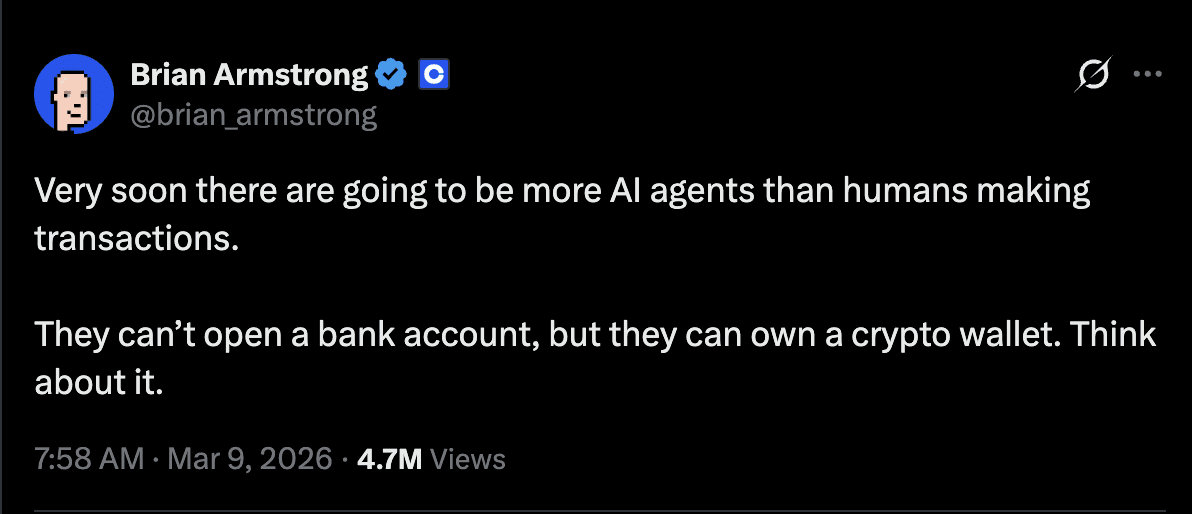
https://x.com/brian_armstrong/status/2031021867973194172?s=20
Carra Wu at a16z put a sharper point on it earlier:
“These agents won’t just be participants, they’ll be creators and operators, driving entirely new economic models.”
The consensus forming isn’t that agents might use blockchains. It’s that agents are already the most natural users of blockchains — and the protocols that make themselves legible to agents now will have a structural advantage over those that don’t.
What’s inside the MCP
The server is built around the full lifecycle of interacting with Carbon DeFi:
Creating strategies.
You can set up a limit order, a range order, a recurring buy low, sell high strategy, a concentrated liquidity position, a full range liquidity position, or trade directly as a taker.
Tell the agent what you want in plain English —
“buy ETH between $2,800 and $3,000, sell between $3,400 and $3,600, keep going”
— and it figures out the right tool, builds the transaction, and hands it back unsigned.
Managing positions.
You can reprice ranges, top up budgets, pause a strategy when you want to sit out some volatility, and resume it when you’re ready. You can even adjust the actual strategy type. All without touching the app.
Exploring the protocol.
Before you put capital to work, you might want to know what pairs have the most liquidity, what strategies are performing, and what the current market price is for a specific token. The MCP pulls live data from the API — TVL, volume by chain, active strategies, trade history — so the agent can give you an actual research briefing — live data, not a generic explainer.
Simulating before committing.
There’s a simulation endpoint that lets the agent backtest a strategy against real historical price data. You can sanity-check a recurring strategy before going onchain. You can compare those results to a concentrated liquidity strategy. You can test different strategies and spreads, gaining insights to how your strategy might produce the best results.
Finding opportunities.
The server includes a find_opportunities function that surfaces orders priced significantly away from current market price — both discount buys and premium sells. This capability can be especially useful for understanding where other makers are positioned.
Migration support.
Bancor recently introduced the new migration feature, and now there’s a helper in the MCP that explains how migration works on Carbon DeFi, what the process looks like, and deep-links you to the app where you can actually do it.
It knows when a user connects their wallet, Carbon DeFi detects supported positions held across leading AMMs. And it knows that from there, liquidity providers can move their existing positions from other major DEXs in one step.
It knows the entire flow is handled in a single atomic transaction.
Throughout all of this, one thing doesn’t change: your keys stay with you. The agent builds it, you review it, you sign it.
By the numbers — what an agent can surface right now
This is the kind of research briefing an agent connected to the Carbon DeFi MCP can pull together on request, live from the API, as of May 2026:
Total TVL across all five chains Carbon DeFi is live
Volume in the first 11 days of May alone, for example
239,728 lifetime trades on the CELO/USDC pair
A single full-range COTI/USDCe strategy with 42,277 lifetime fills — 339 in the last 24 hours
153 active ETH/USDC strategies on Ethereum
The protocol is live on Ethereum, Celo, Sei, TAC, and COTI.
Finding it and connecting it
The Carbon DeFi MCP server works with any MCP-compatible agent. That now includes products from Anthropic, OpenAI, Microsoft, and Amazon, as well as a wide range of open-source and developer tools — among them Claude Desktop, Claude Code, ChatGPT, Cursor, Windsurf, Cline, VS Code with GitHub Copilot, and Nimbalyst for multi-agent workflows. If your agent speaks MCP, it can speak Carbon DeFi.
For Claude Desktop specifically, it’s one config entry:
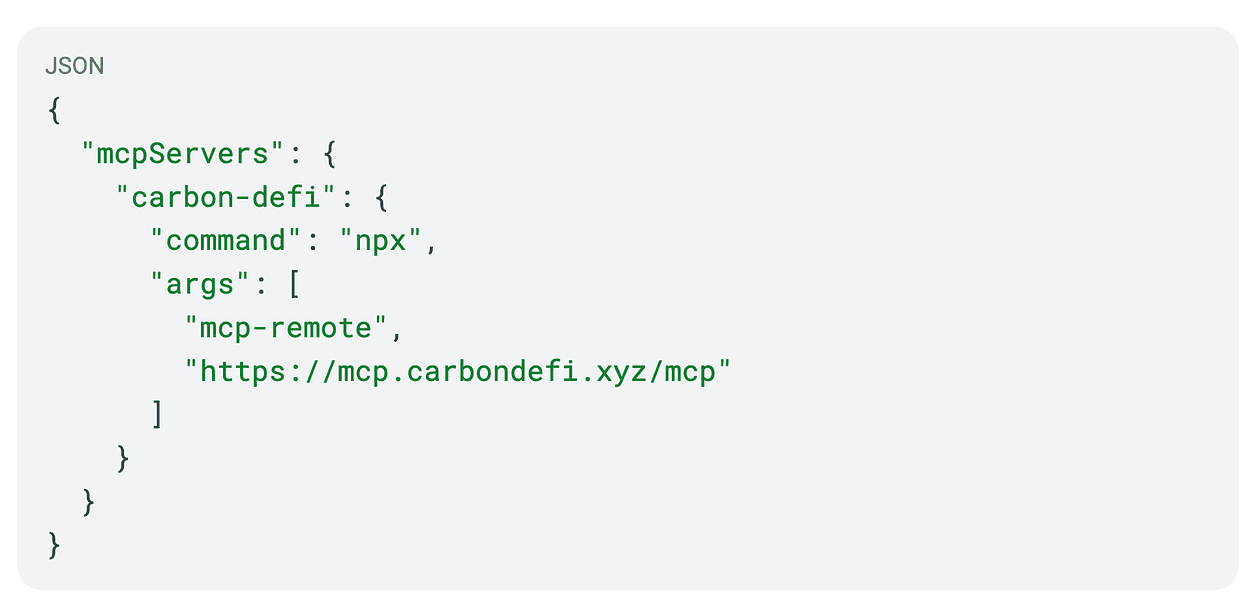
Restart Claude Desktop and all 25 Carbon DeFi tools are available immediately.
For any other MCP-compatible agent or IDE, point it at mcp.carbondefi.xyz. The server is self-describing — most agents will pull the full tool spec on connection and orient themselves from there without additional setup.
The server is also indexed across the major MCP discovery directories for anyone finding it through their agent’s tool ecosystem:
Get Started
The server is live. Point your agent at mcp.carbondefi.xyz, start exploring, and start trading. Part two dives deeper through everything it can do — every tool, every strategy type, every design principle — guided by a real presentation Claude built after connecting.


