

Tokenized gold has grown into a roughly $7 billion market. By February 2026, Reuters reported that nearly 20 gold-backed tokens had already reached close to $6 billion in combined market cap, more than four times the size of the market at the end of 2024. Bitcoin, meanwhile, remains a trillion-dollar market of its own.
The growth of these two markets made me want to revisit an idea I first explored in March 2025: what happens when you stop measuring Bitcoin in dollars and start measuring it in gold?
The idea came from a conversation with Dr. Mark Richardson during one of our Blockchain Banter discussions. Mark used the Carbon DeFi Simulator to backtest a Recurring Order trading tBTC against PAXG. Over several months, the strategy produced roughly 25% ROI measured in gold. You can read the original article here.
Bitcoin vs. Gold: A New Perspective

This time, I wanted to test more than whether Bitcoin and tokenized gold could be traded directly. I wanted to see how much the structure of the strategy would affect the result.
I ran two WBTC/XAUt strategies over the same 365 days of historical price movement. Both used the same initial investment and the same overall price boundaries.
One produced 0.32% ROI above HODL.
The other produced 5.64% — 17.6 times the ROI.
TL;DR
Both strategies:
Started with 1 XAUt and 0 WBTC
Backtested using 365 days of historical market data
Traded between 14.81 and 15.11 XAUt per WBTC
The first used one shared range for buying and selling:
Concentrated Liquidity: 0.32% ROI above HODL
The second used separate buy and sell ranges:
Recurring Order: 5.64% ROI above HODL
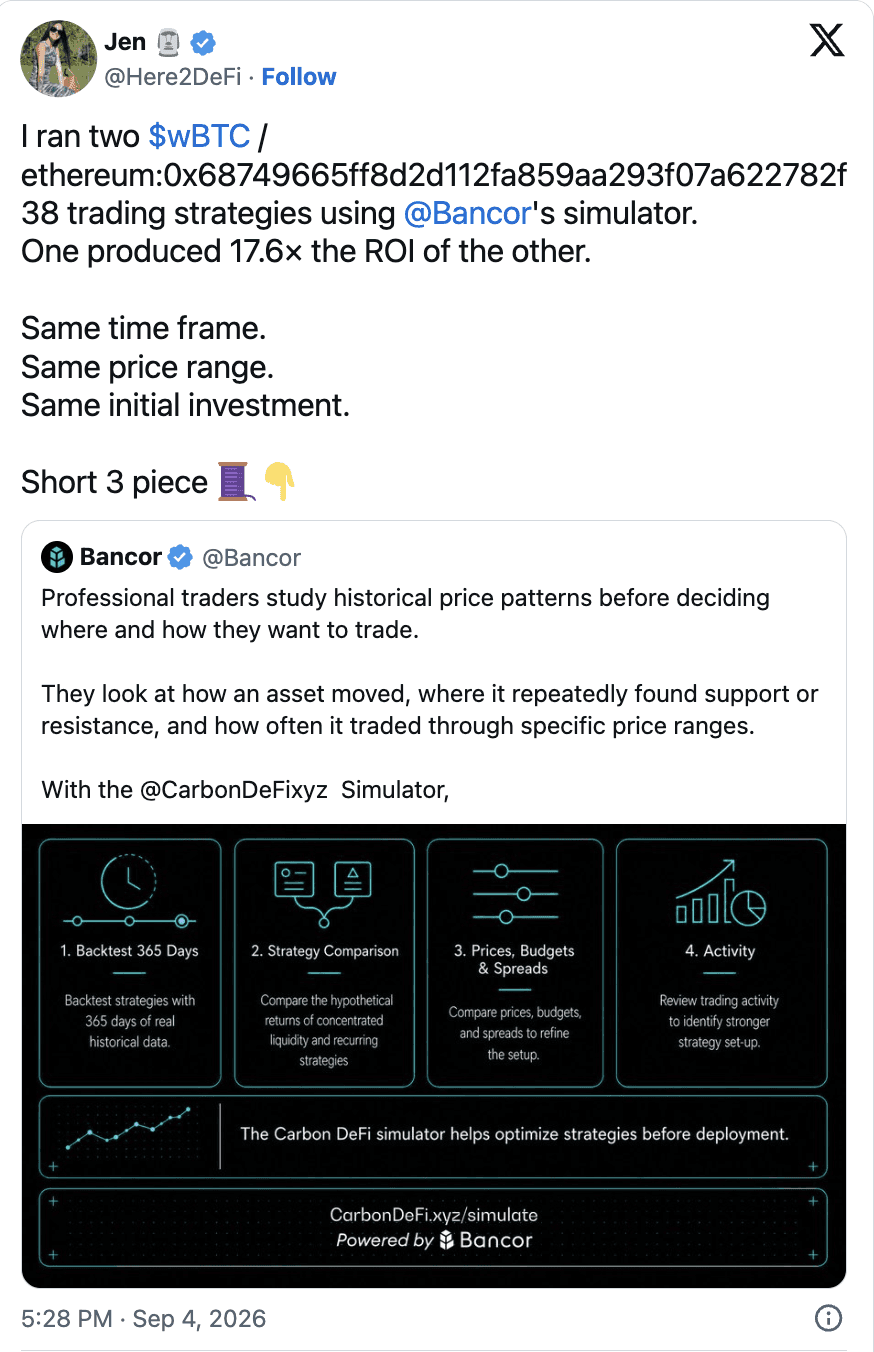
https://x.com/Here2DeFi/status/2096032563550961879?s=20
Strategy One: Concentrated Liquidity
The first strategy used one range for both buying and selling:
Buy and sell: 14.81–15.11 XAUt per WBTC
As the market moves through the range, the position gradually converts between XAUt and WBTC. If it sells WBTC as the market moves upward and the market later reverses, it can buy WBTC back around prices where it recently sold.
There is no independently defined buy range or sell range. The same range handles both directions.
Note that while this strategy began with 1 XAUt, two tokens are generally required to create a Concentrated Liquidity position when the current market price is inside the selected range.
This particular strategy began “out of the money,” meaning the market price was outside its chosen range. That allowed me to fund the position on a single side with 1 XAUt. The strategy became active when the market later moved into the range.
Result
0.32% ROI above HODL
The position traded the market and finished slightly ahead of simply holding the starting asset.
Strategy Two: Recurring Orders
The second strategy used a Recurring Order with separate ranges for buying and selling:
Buy: 14.81–14.95 XAUt per WBTC
Sell: 14.97–15.11 XAUt per WBTC
Instead of allowing both actions to occur throughout one shared range, I gave each side its own instruction.
Buy WBTC with XAUt in the lower range.
Sell that WBTC back into XAUt in the higher range.
The strategy also began with 1 XAUt and 0 WBTC. Unlike an in-the-money Concentrated Liquidity position, a Recurring Order does not require both sides to be funded when it is created.
As the buy order fills, the WBTC it acquires automatically becomes available to the sell order. As the sell order fills, the XAUt proceeds return to the buy order. The cycle can repeat whenever the market moves between the two ranges.
Result
5.64% ROI above HODL
That was 17.6 times the 0.32% generated by the Concentrated Liquidity position over the same historical period.
The Spread Between the Two Ranges Was Only 0.13%
The result becomes more interesting when you look at the spread between the two ranges.
The highest buy price was 14.95 XAUt per WBTC.
The lowest sell price was 14.97.
That is a spread of only 0.02 XAUt per WBTC, or roughly 0.13%.
The 5.64% ROI above HODL didn’t come from setting a wide spread. It came from repeatedly buying and selling as the market moved through those separate ranges.
Additional Features of Recurring Orders
Separate buy and sell orders and custom spread are only two of the benefits of Recurring Orders on Carbon DeFi.
Each side can use a single fixed price or a range of prices, and the prices, ranges and budgets can be defined independently. Makers can fund one side or both sides when the strategy is created.
Recurring Orders can also be adjusted after they are created. Makers can change their prices, add or withdraw funds, change strategy type, or pause and reactivate trading without withdrawing the entire position and creating a new strategy.
Automated Recurring Limit Orders Explained
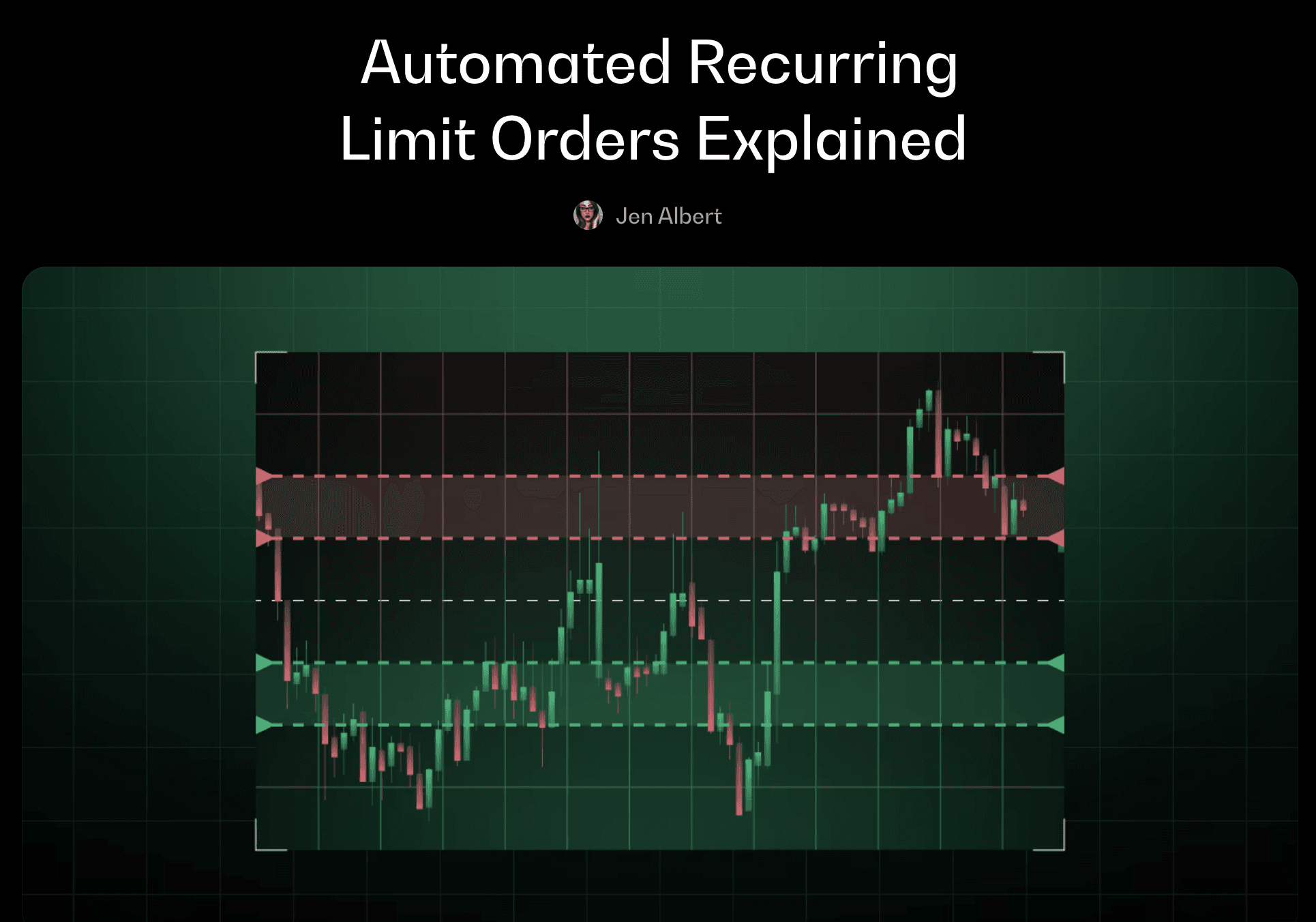
Other key features include:
Full or partial fills
Irreversible execution
No expiration
100% price certainty
No maker fees on filled orders
No third-party dependencies, including oracles, keepers, and hooks
What I Took Away From the Backtest
When I first explored trading Bitcoin against gold, I was interested in whether the relationship between the two assets could be traded directly. Revisiting it showed how much the structure matters once you decide to make that trade.
Both strategies used the same pair, the same starting capital, the same historical period and the same overall price boundaries. The Recurring Order produced 17.6 times the ROI by separating the buy and sell ranges and repeatedly rotating the proceeds between them.
A backtest cannot predict how a strategy will perform in the future. It can show how different prices, ranges, budgets and spreads would have responded to actual market movement before capital is deployed.
In this case, the market and capital remained the same. The instructions changed, and so did the result — by 17.6x.
*If you’re using AI agents, try the Carbon DeFi MCP Server to prepare and manage strategies like these. Your agent prepares the transaction; you review and sign it.
Create automated onchain trading strategies using any MCP-compatible agent
Recommended Reads
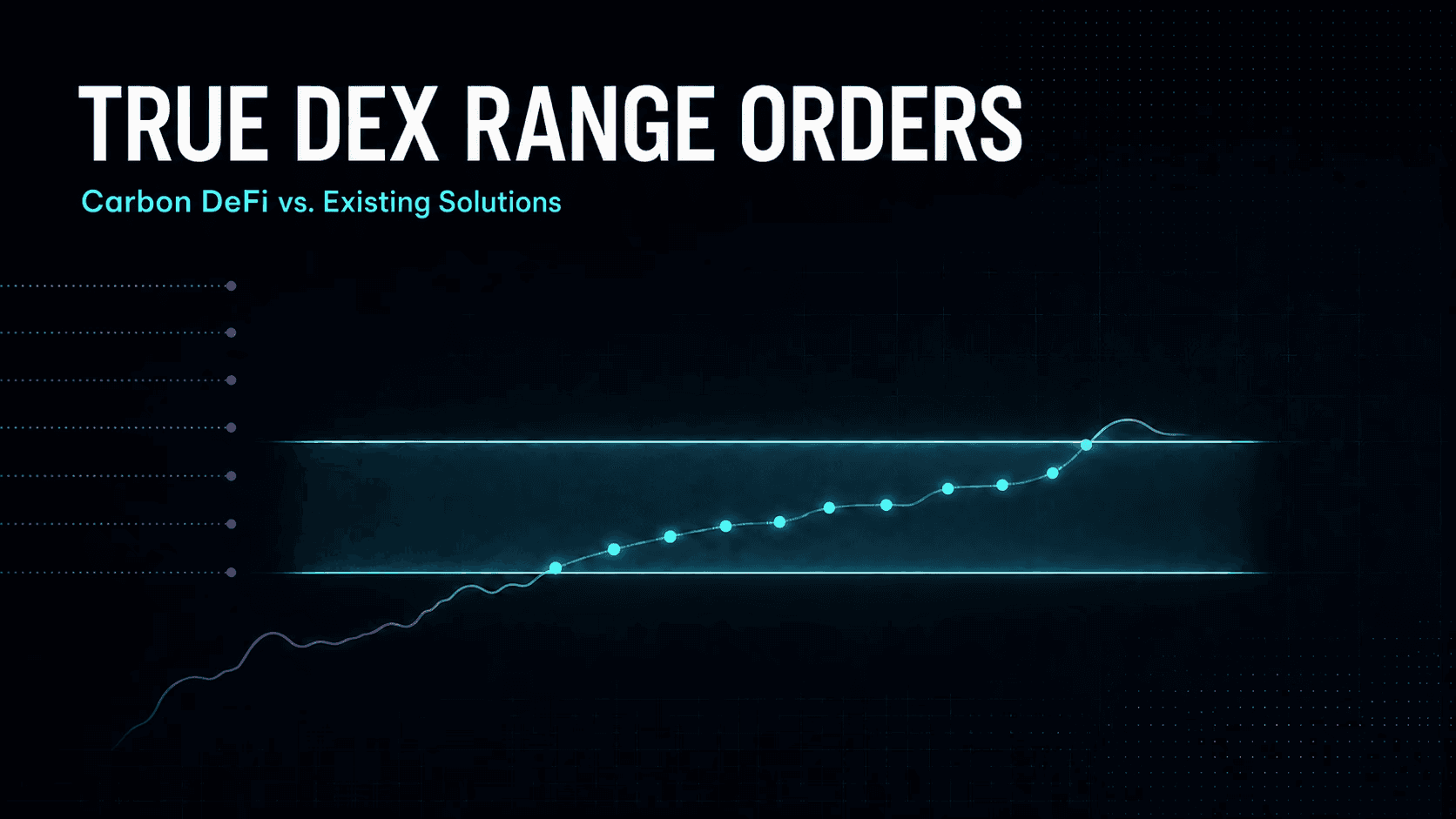
True DEX Range Orders: Carbon DeFi vs. Existing Solutions
AMMs vs. Onchain Orderbooks: What Changes When Makers Control the Curve?
Two Similar Trading Strategies - Two Completely Different Outcomes
Bancor
Bancor is a pioneer in decentralized finance (DeFi), established in 2016. It invented the core technologies underpinning the majority of today’s automated market makers (AMMs) and continues to develop the foundational infrastructure critical to DeFi’s success — focusing on enhanced liquidity mechanics and robust onchain market operation. All products of Bancor, including Carbon DeFi and the Arb Fast Lane, are governed by the Bancor DAO.
Carbon DeFi — Powered by Bancor’s latest patented technologies: Asymmetric Liquidity and Adjustable Bonding Curves.
Live on Ethereum, Sei, Celo, COTI, and TAC.
The Arb Fast Lane — Carbon DeFi’s built-in solver system and DeFi’s most advanced arbitrage infrastructure, powered by Marginal Price Optimization, a new method of optimal routing.
Website | MCP Server | Blog | X/Twitter | YouTube | Governance


