
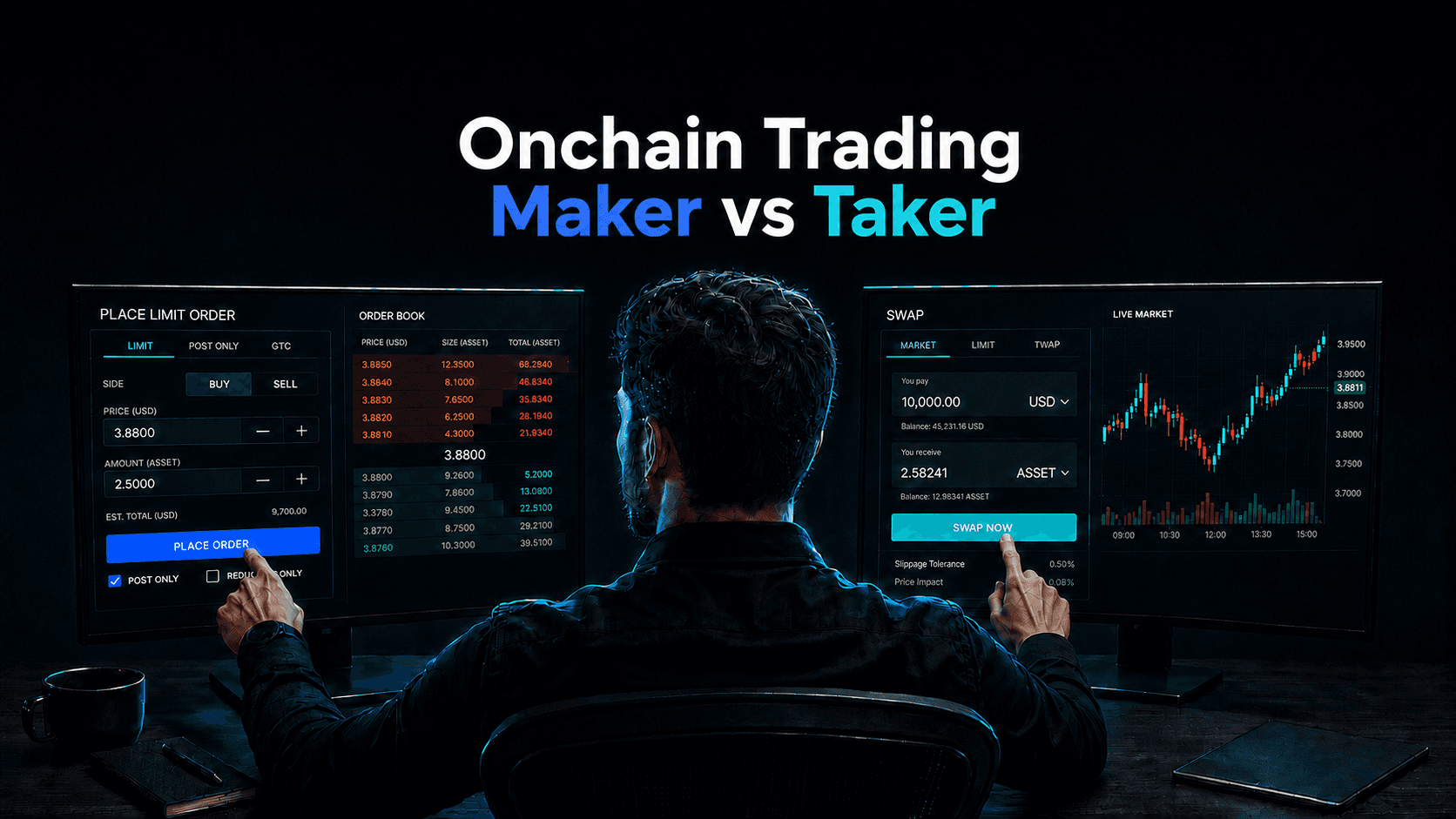
There are always two sides to a trade. You’re either trading against liquidity someone else provided or making your own liquidity available for someone else to trade against. Which side you’re on determines how much, or how little, control you have over the outcome.
In my previous article, “AMMs vs. Onchain Orderbooks: What Changes When Makers Control the Curve?”, we looked at how different DEX architectures organize and execute maker liquidity.
This article looks at the same market from the trader’s side.
TL;DR
A maker provides liquidity for someone else to trade against.
A taker trades against liquidity that someone else has already made available.
The tradeoff between immediate execution and predefined terms.
Makers and takers on an AMM.
Makers and takers on an orderbook.
Making the switch from taker to maker.
Trading against chainwide liquidity vs a single liquidity pool.
Makers and Takers on an AMM
Makers
Who we commonly refer to as liquidity providers. They provide liquidity, aka make a market. They deposit tokens into a shared pool for traders to trade against.
Every time someone buys a token from the pool, the maker is the one selling it. Every time someone sells a token into the pool, the maker is the one buying it.
Pros
Earn “fees” when traders use the pool.
*I say ‘fees’ loosely. This is the widely accepted term in our industry and easily understood by most, but it is important to gain a true understanding of ‘fees’ in this context. See ‘Fixing Objectively Bad Models in Crypto’ — Bancor Project Lead, Dr. Mark Richardson’s presentation and argument at EthCC Brussels as to why ‘fees’ don’t actually exist.
Cons
The pool controls the pricing logic.
While concentrated liquidity gives the maker more control over where they’re providing liquidity, or making a market, the pool still determines how it buys and sells within that range.
In a constant-product AMM, the maker has zero control over where they are providing liquidity, or making a market, or the individual prices they are buying or selling at.
The pool’s curve and underlying mechanics determine:
The available prices for takers (those swapping into the pool).
How the price changes as liquidity is consumed.
How the position buys and sells as the market moves.
Risk of loss in overall position value. As traders remove the appreciating token and add the depreciating token, makers can be left holding more of the weaker asset.
Takers
The ones trading against the pool, or swapping their tokens.
Pros
Immediate onchain execution
Cons
The execution price is never guaranteed.
Inevitable price impact on every trade. The ‘price’ is only the price until a trade is executed.
Slippage (the loss a taker is willing to accept on each trade) must be pre-determined in order to mitigate loss.
Execution outcome depends on the liquidity available in a single pool.
Paying trading fees, protocol fees, and potential UI fees.
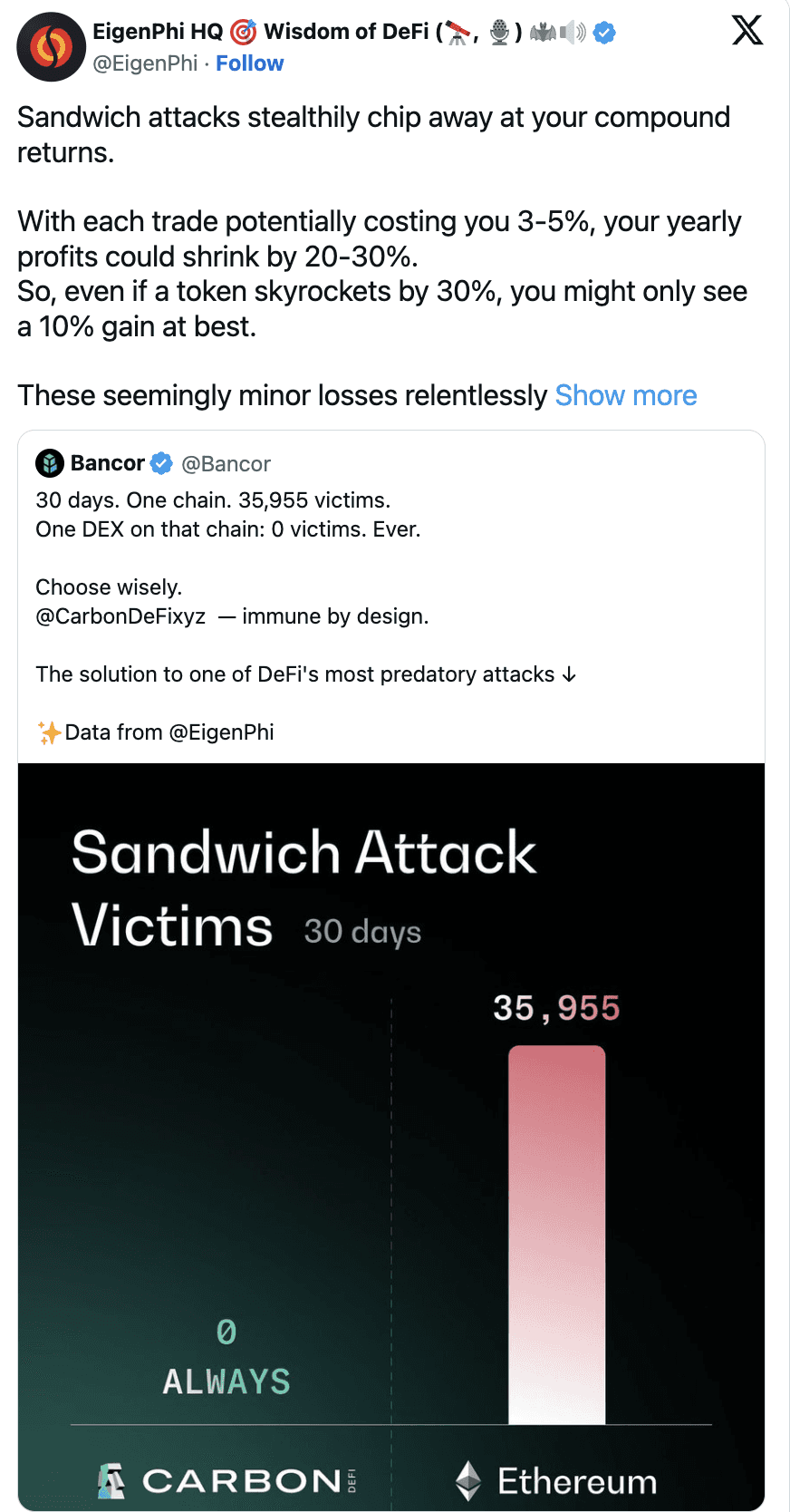
Exposure to MEV sandwich attacks.
*For more on sandwich attacks, I recommend the following:
1. Understanding MEV Sandwich Attacks — Frequently Asked Questions
2. How to Gain Immunity From MEV Sandwich Attacks — The Solution to One of DeFi’s Most Predatory Attacks
3. No sandwiches allowed — how to prevent MEV attacks on AMMs
Makers and Takers on a Traditional Orderbook
Makers
Publish offers specifying how much they are willing to buy or sell and at what price, creating the market by way of limit orders.
For example, a maker may offer to sell 100 tokens at $1.00.
Pros
Direct control over price and quantity of each offer.
Ability to place separate bids and asks.
Ability to distribute liquidity across several pre-determined prices.
Generally pay lower fees vs takers.
Cons
Buying or selling through a price range, rather than one specific price, means creating and maintaining dozens of individual orders.
No guarantee that orders will fill.
Multiple orders may need to be monitored and adjusted.
Orders may expire.
Takers
Accept the orders in the order book (created by the maker).
Using the example above, a maker may offer to sell 100 tokens at $1.00.
A taker who accepts the offer can buy those 100 tokens at the maker’s price.
Pros
Visible prices and quantities.
Immediate execution when sufficient orders are available.
Ability to choose from existing bids and asks.
Cons
Execution remains limited by the liquidity makers have published.
Larger trades may consume several price levels.
Execution quality depends on orderbook depth.
If the taker wants 300 tokens but only 100 are available at $1.00, the remaining amount must come from additional sell orders at other prices.
Generally pay higher fees for the convenience of instant execution.
Making the Switch From Taker to Maker
Most onchain traders default to the position of takers. They perform a swap by:
determining which two tokens they want to trade
entering the amount they want to trade
setting their slippage tolerance
hoping they don’t get sandwich attacked
accepting the outcome (the price they receive after the trade is executed).
Carbon DeFi, an onchain orderbook-style DEX, encourages that same trader to become the maker.
Instead of accepting the price available from someone else’s liquidity, the trader creates an order and defines their execution terms in advance.
They can do this in one of three ways by creating a:
Limit Order: Buy or sell at one predetermined price.
Range Order: Buy or sell progressively through a predetermined price range.
Recurring Order: Automatically repeat a predetermined buy-low, sell-high trading cycle.
All three give the maker 100% price certainty and immunity to MEV sandwich attacks.
Orders can fill completely or partially and remain active until they are filled, paused or cancelled. The maker pays no fees or gas when an order fills and can adjust the order onchain without withdrawing their tokens and starting again.
Switching from taker to maker does not necessarily mean waiting for the market to reach a future price.
A trader who wants to execute near the current market price can create a Limit Order at that price. If another trader or Carbon DeFi’s built-in solver accepts the order, it executes at the maker’s exact price without slippage or exposure to a MEV sandwich attack.
Immediate execution is not guaranteed, but the execution terms are.
The Benefits of Carbon DeFi
Pre-set your trades
Makers define their trades in advance. There is no need to watch the charts, wait for the right opportunity and manually submit a swap when the market reaches their price.
The order is already in place and available to be filled according to the maker’s predefined terms.
100% price certainty
The maker determines the amount they want to receive, and if their order is filled, they receive that exact amount.
Immunity to MEV sandwich attacks
Makers and takers are both immune to sandwich attacks. Due to the underlying mechanics of Carbon DeFi (its architecture is different from that of an AMM), execution prices cannot be manipulated.
*For more on Asymmetric Liquidity and Carbon DeFi’s single token pricing curves, see the Carbon DeFi whitepaper and invention disclosure.
Full and partial fills
An order does not need to be filled all at once. It can be filled partially through multiple trades until the full budget has been depleted.
Irreversible execution
Orders, whether fully or partially filled, do not reverse if the market retraces.
No expiry
Orders remain active until filled, paused, adjusted or cancelled.
Adjustable onchain
Makers can change prices, ranges, budgets and strategy type without withdrawing and rebuilding the position.
Zero maker fees on fills
Makers do not pay protocol, gas or trading fees on filled orders.
Zero third-party dependencies
All features of Carbon DeFi are native to the protocol. It does not rely on an oracle, keeper, hook or any third-party infrastructure.
Exploits Targeting External Dependencies Have Cost DeFi Over $630 Million in 2026

Trading Against Chainwide Liquidity vs. a Single Liquidity Pool
When trading against a traditional AMM, the execution price is determined by AMM mechanics and the liquidity available in that pool.
Carbon DeFi orders are not limited to the available liquidity on Carbon DeFi itself. They can be discovered and filled using liquidity available across the wider market.
Once a strategy is created, anyone can trade against it, including Carbon DeFi’s built-in solver system. The solver acts as a de facto taker, searching for opportunities to fill orders using liquidity from all major DEXs chainwide.
Make or Take: The Tradeoff
Trading as a taker makes sense when immediate execution is the priority. You accept the price and liquidity available at that moment to complete the trade now.
When the execution price matters more, when time away from the charts matters more, create an order and become the maker. Even when targeting the current market price, a Carbon DeFi Limit Order provides price certainty and immunity to MEV sandwich attacks.
Most onchain traders default to taking liquidity. Carbon DeFi provides them with the tools necessary to make their liquidity available on their own terms, and let the wider market come to them.


